Class Structure
Projects Covered:
- Each classes will start with the warmups/stretching.
- Namaskaram
- Adavus warmups
- Learn new adavus
- Break
- Theory
- Namaskaram
- Stretching
- End of the class
No feedback given yet.
Students have to practice the adavus/ items that they learn on each week.
No practice materials available for this chapter.
Thattadavu 1 - 8
Projects Covered:
- Thattadvu 1 – (Completed)
- Thattadvu 2 – (Completed)
- Thattadvu 3 – (Completed)
- Thattadvu 4 – (Completed)
- Thattadvu 5 – (Completed)
- Thattadvu 6 – (Completed)
- Thattadvu 7 – (Completed)
- Thattadvu 8 – (Completed)
No feedback given yet.
No homework given yet.
No practice materials available for this chapter.
Naattadavu 1 - 8
Projects Covered:
- Naattadavu 1 – (Completed)
- Naattadavu 2 – (Completed)
- Naattadavu 3 – (Completed)
- Naattadavu 4 – (Completed)
- Naattadavu 5 – (Completed)
- Naattadavu 6 – (Completed)
- Naattadavu 7 – (Completed)
- Naattadavu 8 – (Completed)
No feedback given yet.
No homework given yet.
No practice materials available for this chapter.
Paraval Adavu 0 - 4
Projects Covered:
- Paraval adavu 0 – (Completed)
- Paraval adavu 1 – (In progress)
- Paraval adavu 2 – Completed)
- Paraval adavu 3 – Completed)
- Paraval adavu 4 – Completed)
No feedback given yet.
Paraval Adavu 0 - 4
Chapter is not started yet
Theories
Projects Covered:
- Introduction of Bharathanatyam – (Completed)
- Namaskaram – (Completed)
- Postures – (Completed)
- Single Hand Gestures (Asamyuta Hastas) – (In progress)
- Double Hand Gestures (Samyuta Hastas) – (Not – started)
- Devata Hastas – Shiva, Vishnu, Ganapathi – (In progress)
- Natya Sastra – (Not – started)
- Abhinaya (expression) – (In progress)
- Rasa – (In progress)
- Bhava – (Not – started)
No feedback given yet.
No homework given yet.
Introduction of Bharathanatyam:
Bharathanatyam is the classical dance of Tamil Nadu which originated in the temples. It involves body discipline, dedication and above all, perseverance.
Years of rigorous practice go into a making a professional Bharathanatyam dancers. It can be performed by all genders as it is comprises two forms of dance – Tandava and Lasya, respectively for men and women.
It takes at least seven to eight years to complete a full repertoire of Bharathanatyam.
Namaskaram:
Namaskaram (नमस्कारं ) is the traditional way to start a dance session. Before and after every dance practice, we do a Namaskar as a way of offering our prayers to the Lord, the audience, our Guru and Mother Earth – for letting us dance on her.
Postures:
Some leg postures (Mandala) in Bharatanatyam are –
- Samapadam or Sthanakam
- Aramandi or Ardhamandala
- Muzhumandi
- Swastika
- Prenkhana

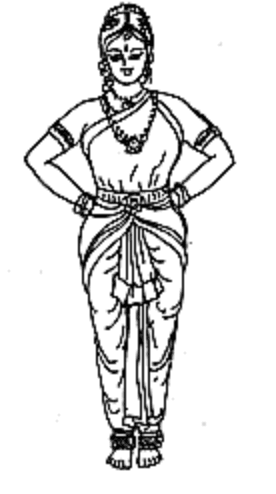
1. Samapadam or Sthanakam
It is the basic posture of the body in Bharatanatyam in which the body should be straight, legs slightly bent at knees and toes facing sideways, the body is erect – nether too relaxed nor too firm.
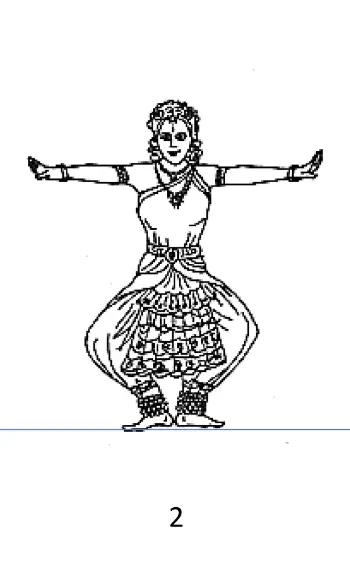
2. Aramandi / Ardhamandala
It is perhaps the most important (and hardest) posture in Bharatanatyam, “Arai” is a Tamil word which means “Half” and “Mandi” means “to sit”. Hence, this is a posture of Half-Sitting. Almost every step in Bharatanatyam will involve the dancer sitting in the Aramandi posture. – In this posture, the dancer’s heels are joined together, the toes of both legs pointed to the opposite direction. A straight line should form from one end of the toe to the other end. – Then, the dancer squats halfway down, making sure to maintain the feet in same position. When the dancer sits this way, a diamond shape will form between the legs which must be maintained at all times for a good Aramandi. Maintain a gap of 2 fingers between your feet.

3. Muzhumandi
“Muzhu” {read: Moo-loo – twist up the tongue while saying “Zhu” (Loo)} – means “FULL”. In this posture, the dancer sits down completely, maintaining the same feet positions as in Aramandi. – Join heels and point toes to opposite directions – Sit down on your toes while still making sure the heels are joined (or as close as possible) – The thighs have to be stretched out in opposite directions and back erect
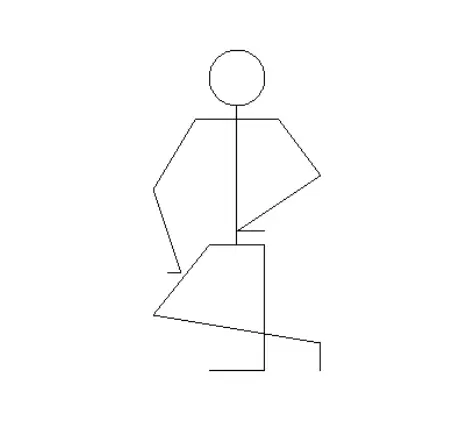
4. Swastika
Performed in Aramandi or Sthanakam position keep right leg (on the toes) across the left (flat)
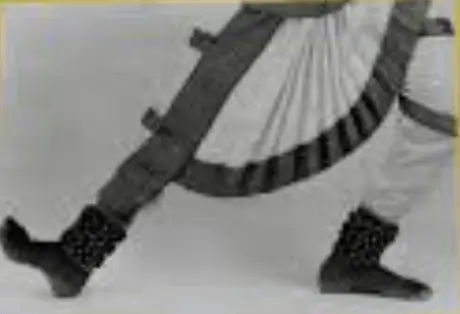
5. Prenkhana
Performed in Aramandi or Sthanakam position. Introduced in Natta Adavu Keep left leg in Aramandi/Ayatham and right leg stretched to the side on heel
Theories
Projects Covered:
- Dhyana Shlokam – (In progress)
- Guru Dhyana Shlokam – (Completed)
- Shlokha 3 – (Not – started)
- Shlokha 4 – (Not – started)
No feedback given yet.
No homework given yet.
Dhyana Shlokam
Aangikam Bhuvanam Yasya
Vachikam Sarva Vaanmayam
Ahaaryam Chandra Taaradi
Tam Vande Sattwikam Shivam
Meaning:
We bow to the Lord Shiva,
Whose body is the whole Universe,
Whose speech is the entire languages,
And whose ornaments are the moon stars…
Aangikam – Body
Bhuvanam – Universe
Yasya – Whose
Vaachikam – Speech
Sarva – All
Vaanmayam – Languages (Sound)
Aaharyam – Ornaments
Chandra – Moon
Taara – Stars
Aadi – Etc.
Tam – That
Vande – Bow
Saatvikam – Pure
Shivam – Lord Shiva
Guru Dhyanam Shloka
Gururbrhama GururvishNuhu
Gururdevoa maheaShvarah
Guru SsaakshaatPara Brahma
Tasmai Shree Guravenamah
Meaning:
Guruvu (Teacher) is Bhrama
Guru is Vishnu
Guru is the Maheshwarah
Guru is the great God himself
we offer our obeisance to you.
Guruvu or Guru (Teacher or Master) is revered greatly by us as he is a wealth of knowledge. And by offering our sincere obedience to him we expect to gain knowledge from him. Master or Teacher is the one who would direct us to the path of Enlightenment, and save us from the darkness of ignorance. Hence Teacher should be given profound honour and respect.
Shlokam 3
Pancha Nadai 1 - 8
Projects Covered:
- Tishram – (Completed)
- Chatushram – (Completed)
- Kandam – (Completed)
- Mishram – (Completed)
- Sankeernam – (Completed)
No feedback given yet.
No homework given yet.
Pancha Nadai refers to the five rhythms that lay the foundation for Bharatanatyam. This dance is created in the counts of 3, 4, 5, 7 and 9. These counts can also be used to form geometrical shapes like a quadrilateral for the 4-beat chaturasram and a pentagon for the 5-beat khandam.
Pancha nadai:
- Beats of 3 – Tishram – Tha ki ta
- Beats of 4 – Chatushram – (Tha ka di mi)
- Beats of 5 – Kandam – (Tha ka Tha ki ta)
- Beats of 7 – Mishram – (Tha ka di mi Tha ki ta)
- Beats of 9 – Sankeernam – (Tha ka di mi Tha ka Tha ki ta)